

Salesforce is ramping up its AI agent management capabilities with new observability features in its Agentforce 360 platform, aiming to give enterprises insight into AI agent behavior and performance.
The move addresses a critical pain point for organizations scaling AI agents beyond initial deployment — the need for continuous monitoring, optimization, and transparency.
The agent lifecycle traditionally spans build, test, and deploy phases. But as Salesforce points out, “Once agents begin handling real transactions, they often become black boxes.” Without visibility into how and why agents make decisions, enterprises face challenges in tuning, trust, and scaling AI effectively.
Adam Evans, EVP and GM of Salesforce AI, emphasizes this shift: “As AI adoption accelerates, the biggest enterprise challenge will no longer be about building an organization’s first agent; it will become how to best manage a fleet of agents that are making real-world business decisions. You can’t scale what you can’t see.” He adds, “Agentforce delivers the enterprise-grade operational rigor required for this new agentic world. We’re giving IT leaders the critical tools to continuously track performance, debug issues, and prove the ROI of their AI investments, ensuring every intelligent agent performs reliably, securely, and with total transparency.”
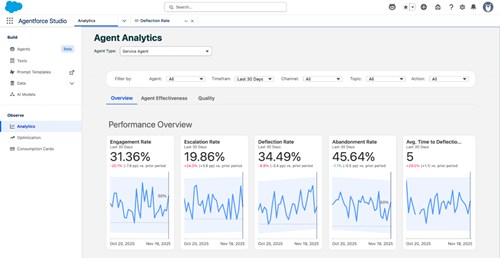
Salesforce Agent Analytics. Image source: Salesforce
Deeper Observability Across Analytics, Optimization, and Health
The new tools focus on three core areas:
-
Agent Analytics: Provides a comprehensive, continuous view of agent performance with detailed metrics on usage, effectiveness, and KPI trends. Teams can pinpoint where agents excel or falter and take targeted action to improve.
-
Agent Optimization: Offers full traceability into agent reasoning and session flows. Businesses can observe every interaction step-by-step, cluster similar sessions to identify patterns, and diagnose performance gaps to fine-tune agent configurations.
-
Agent Health Monitoring: Ensures uptime and reliability by delivering near-real-time status updates and alerts on critical issues like errors or latency spikes — essential for maintaining trust and operational resilience during peak demand.
These capabilities are underpinned by Salesforce’s Session Tracing Data Model, which logs every interaction detail securely in Data 360, and the new MuleSoft Agent Fabric, a centralized hub to register, govern, and observe agents regardless of their origin.
By integrating these observability tools with MuleSoft governance and unified data context, Salesforce aims to empower enterprises to confidently scale AI agents across customer, employee, and backend workflows — transforming AI from isolated projects into fully managed, transparent fleets.
For more information visit the Salesforce website.